








From November 17 to 18, Mr. Huang Kunming, Party Secretary of Guangdong Province and Politburo Member of the Communist Party of China visited Shenzhen for field research at ports, major scientific facilities, and distinctive neighborhoods. He underscored the need to thoroughly study and implement the principles of the Fourth Plenary Session of the 20th CPC Central Committee and to earnestly carry out President Xi Jinping's important speeches and instructions delivered during his inspection tour of Guangdong and attendance at the opening ceremony of the 15th National Games. Huang called for a high-level and forward-looking approach to formulating the "15th Five-Year Plan," and for deepening Reform and Opening-up with the drive and courage required to stay at the forefront. The aim is to cultivate new advantages, achieve new breakthroughs, deliver stronger results in building the Pilot Demonstration Area of Socialism with Chinese Characteristics, and accelerate the creation of a model city for China's socialist modernisation.
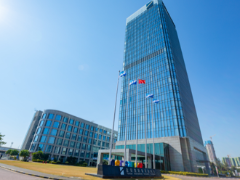
The major scientific facility for synthetic biology research in Guangming District—completed and commissioned last year—is dedicated to foundational research and industrial applications in synthetic biology. During his visit, Huang inspected the laboratories and intelligent production lines, viewed displays of innovations incubated by the facility, and gained an in-depth understanding of R&D progress and the translation of research outcomes into practical applications. Huang emphasised that synthetic biology is a key frontier of the new round of scientific and technological revolution and industrial transformation, with vast potential for industrialisation. He called for fully leveraging the catalytic role of major scientific facilities, innovating research organisation models, and deepening collaboration among industry, academia, and research institutes to secure more breakthroughs in critical technologies and generate more innovative research outcomes, continuously amplifying early-mover advantages. He urged stronger efforts to advance real-world applications of synthetic biology in high-end healthcare, efficient agriculture, materials modification, food processing, and other fields, thereby fostering new opportunities and new development space for emerging industries. He also highlighted the importance of strengthening FinTech, encouraging state capital to increase lead investments, and mobilising more market capital to invest earlier, invest smaller, and invest in hard-tech ventures, accelerating the transformation of scientific and technological innovations into real productive forces.
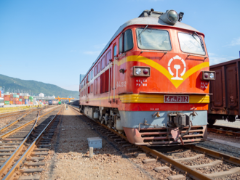
In Yantian District, Huang began his tour at Chung Ying Street. He walked through the distinctive streetscape, engaged in friendly conversations with tourists, and visited shops to inquire about customer flow and sales. He stressed the need to fully leverage the street's historical and cultural resources by enhancing its unique features, improving the environment, and diversifying its business offerings. He also called for collaborative efforts with Hong Kong to introduce more measures facilitating cross-boundary travel, upgrading the tourism and consumption experience, and developing a cross-border commercial and cultural hub that preserves historical memories and highlights the appeal of the Greater Bay Area. Later, Huang visited YANTIAN, where he inspected its operations, smart port initiatives, and plans for port traffic network. He noted that the port's transformation from a barren salt flat into a mega hub port handling tens of millions of TEUs represents a historic achievement and a landmark project in the modernisation of Shenzhen city and Guangdong province. This remarkable development, he said, demonstrates the vitality brought by Reform and Opening-up and reflects the promising prospects of the Greater Bay Area. He emphasised the port's critical role in supporting modernisation and urged forward-looking planning for high-quality development in the "15th Five-Year Plan" period. This includes advancing intelligent upgrades to optimise services, improve efficiency, and reduce costs; proactively expanding shipping services; strengthening collection and distribution capacity; and developing new services such as LNG bunkering. He also highlighted the importance of strengthening coordination among Pearl River Delta ports to jointly build a world-class port cluster in the Greater Bay Area.
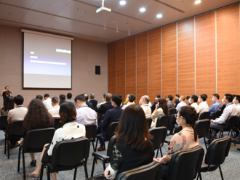
During the inspection, Huang fully affirmed Shenzhen's new progress in various tasks since the beginning of the year. He emphasised that this year holds particular significance as it marks both the conclusion of the 14th Five-Year Plan and the preparation for the 15th Five-Year Plan, while also commemorating the 45th anniversary of Shenzhen's establishment as a Special Economic Zone. Huang urged Shenzhen to bear in mind the President Xi Jinping's earnest expectations and shoulder its substantial historical responsibilities. He called for carrying forward the spirit of Reform and Opening-up, and the Special Economic Zone, and advancing pioneering and demonstrative initiatives from a new starting point. The city should carefully chart its development course for the next five years, further consolidate and expand advantages, address bottlenecks, and reinforce areas of weakness, fully boosting the momentum and vitality for high-quality development and achieving new, higher-level outcomes in serving the overall interests of both the nation and the province. Shenzhen should, with greater intensity, promote the deep integration of scientific and technological innovation with industrial innovation, accelerate key technological breakthroughs and the transformation of research findings into practical applications, and enhance institutional support in emerging fields and sectors. The city should strive for critical breakthroughs in areas such as artificial intelligence, integrated circuits, biopharmaceuticals, and new materials, foster new industrial pillars, and develop a more internationally competitive modern industrial system. With stronger commitment, Shenzhen should advance the development of the Greater Bay Area, concentrating efforts on both infrastructure "hard connectivity" and regulatory "soft connectivity." By leveraging major cooperation platforms like Qianhai and Hetao, the city should deepen practical collaboration with Hong Kong and Macau in science and technology, industry, finance, and commerce, and enhance market integration. These efforts will help strengthen Shenzhen's role as a core engine, solidly supporting Guangdong's position as a main and leading development force. Shenzhen should make thorough preparations for the upcoming APEC meetings, firmly assuming political responsibility, adhering to high standards and strict requirements, and strengthening coordinated planning. By concentrating resources and working in accordance with established timelines, the city should ensure orderly and effective progress in all preparatory work. This process should also drive the modernisation of urban governance systems and capabilities, realising comprehensive urban advancement and the vision of "elevating the city by hosting a major event." The city should continue its efforts in organising the National Games and preparing for the Special Olympics. A meticulous approach should be applied to refining all processes, including security, reception, medical support, food safety, volunteer services, and transportation management, to ensure the complete success of these events. Embracing a reform-oriented and innovative mindset, Shenzhen should strengthen the Party's comprehensive leadership and organisational building, with a clear focus on grassroots-level work. The city should resolutely persist in the ongoing, comprehensive fight against corruption and strive to develop a contingent of cadres who demonstrate strong Party commitment, broad vision, innovative capability, and pragmatic action. This will provide solid assurance for advancing high-quality development and modernisation. As the year draws to a close, Shenzhen should intensify efforts to complete annual tasks, focusing on stabilising employment, enterprises, markets, and expectations. The city should enhance economic supervision and regulation, spare no effort in preventing risks, ensuring security, and maintaining stability, striving to achieve all annual objectives.
Provincial government leader Feng Zhonghua and Shenzhen Mayor Qin Weizhong accompanied the inspection.